API Gateway Deep Dive: Fundamentals, JWT Auth & Revocation Strategies
On this page
A comprehensive guide to how API Gateways work, how they validate JWTs, and the tradeoffs behind token revocation.
Table of Contents
Part 1: API Gateway Fundamentals
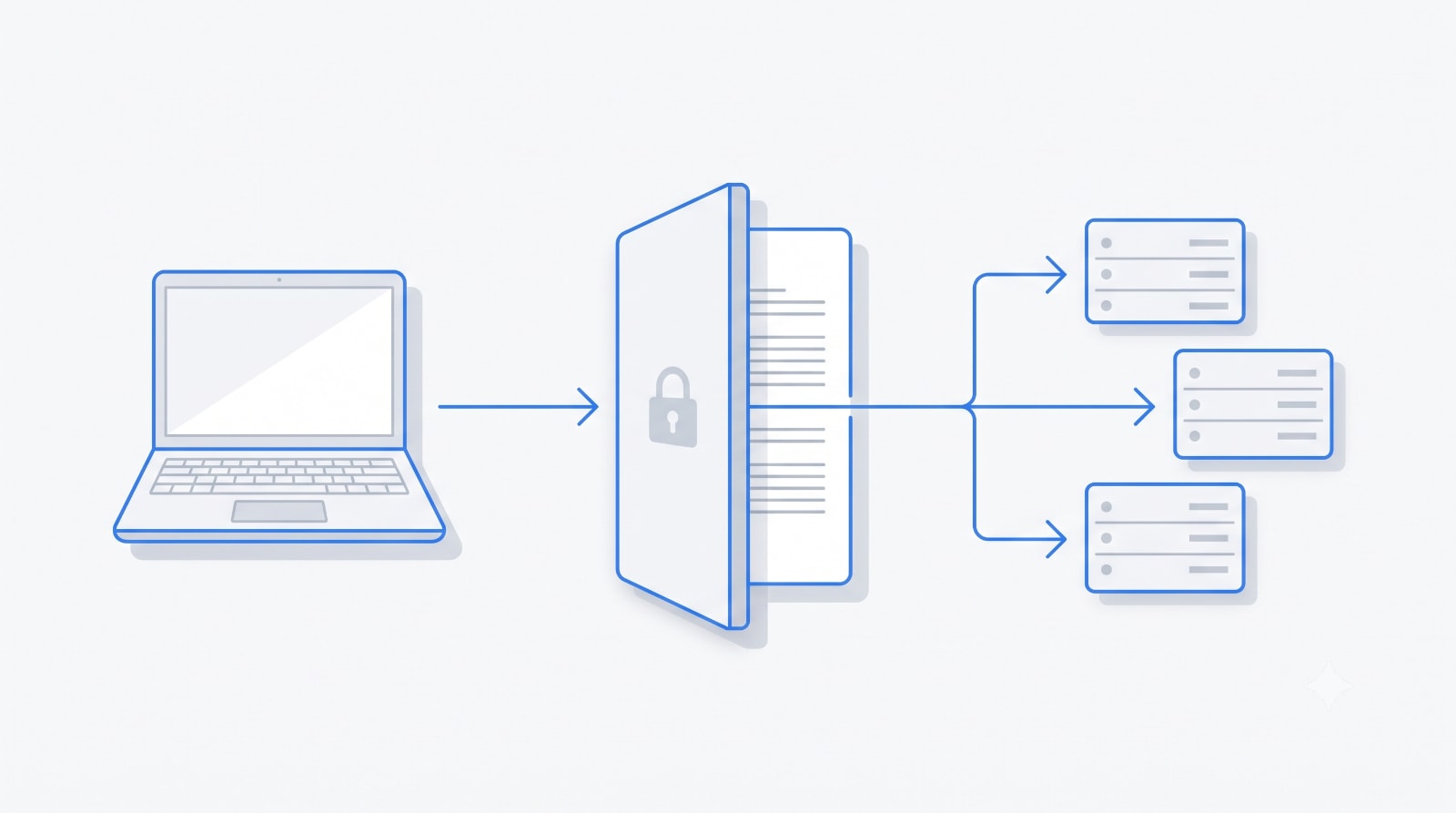
An API Gateway is a centralized server or software layer that sits between client applications and backend microservices. It acts as the single entry point for all incoming traffic, adopting a "dumb backend" philosophy — the Gateway handles the heavy lifting so microservices can focus purely on business logic.
How It Fits in the Architecture
Core Responsibilities
| Responsibility | What It Does |
|---|---|
| Request Routing | Acts as a reverse proxy, directing API calls to the exact microservice required |
| Authentication & Security | Serves as the front door — validates tokens, blocks unauthorized or malicious requests |
| Rate Limiting & Throttling | Prevents system crashes and DDoS attacks by capping requests per user/IP |
| Response Aggregation | Combines data from multiple backends into a single response, reducing round-trips |
| Load Balancing | Distributes traffic evenly across multiple instances of a service |
Market Landscape
When to choose which:
- Managed Cloud — Best for teams already embedded in a cloud ecosystem
- Open-Source / Self-Hosted — Best for low latency requirements and custom plugin needs
- Developer-First & Edge — Best for code-centric teams deploying across global edge networks
Part 2: JWT Authentication Flow
When a client sends an API request with a JWT in the Authorization: Bearer header, the Gateway executes a strict, stateless validation process before the backend ever sees the traffic.
The 4-Step Validation Flow
Key Insight: The Cryptographic Handshake
The Gateway never needs to call the IdP for routine requests. It uses the IdP's Public Key (fetched once and cached) to mathematically verify the token's signature. If algorithm(Payload + PublicKey) matches the Signature, the Gateway has cryptographic proof that:
- The token was created by the trusted IdP (who holds the Private Key)
- The token's contents have not been tampered with
The backend microservice then blindly trusts the X-User-ID header injected by the Gateway — it never sees raw JWTs.
Part 3: JWT Revocation Strategies
Because JWTs are stateless and validated mathematically, they cannot be natively "revoked" from afar. Once minted, a token remains valid until its exp claim hits. Architects use one of three strategies to handle forced logouts or bans, each with distinct tradeoffs.
Strategy Comparison at a Glance
Strategy 1: Short Expirations + Refresh Tokens (Industry Standard)
Tradeoff: Maintains high Gateway performance (no extra network calls). Accepts a small window of vulnerability — up to ~15 minutes where a revoked user's Access Token still works.
Strategy 2: Gateway Blocklist / Denylist (High Security, High Speed)
Tradeoff: Near-instant revocation with very low latency impact (a Redis lookup adds ~1ms). Requires managing a cache and setting correct TTLs to avoid memory bloat.
Strategy 3: Stateful Token Introspection (Maximum Control)
Tradeoff: Maximum, instant control — revocation is centralized at the IdP. But every request now incurs a network round-trip to the IdP, increasing latency and introducing a single point of failure. If the IdP crashes, all API traffic fails.
Decision Framework
Summary
| Strategy | Revocation Speed | Latency Impact | Complexity | Best For |
|---|---|---|---|---|
| Short Expiry + Refresh | ~15 min window | None (no extra call) | Low | Most production APIs |
| Gateway Blocklist (Redis) | Instant | ~1ms (Redis lookup) | Medium | High-security apps |
| Stateful Introspection | Instant | High (IdP round-trip) | High | Extreme compliance needs |
The industry standard for most teams: Short expiry Access Tokens (15 min) + long-lived Refresh Tokens, with a Gateway Blocklist layered on top for high-value sessions (admin tokens, payment flows).